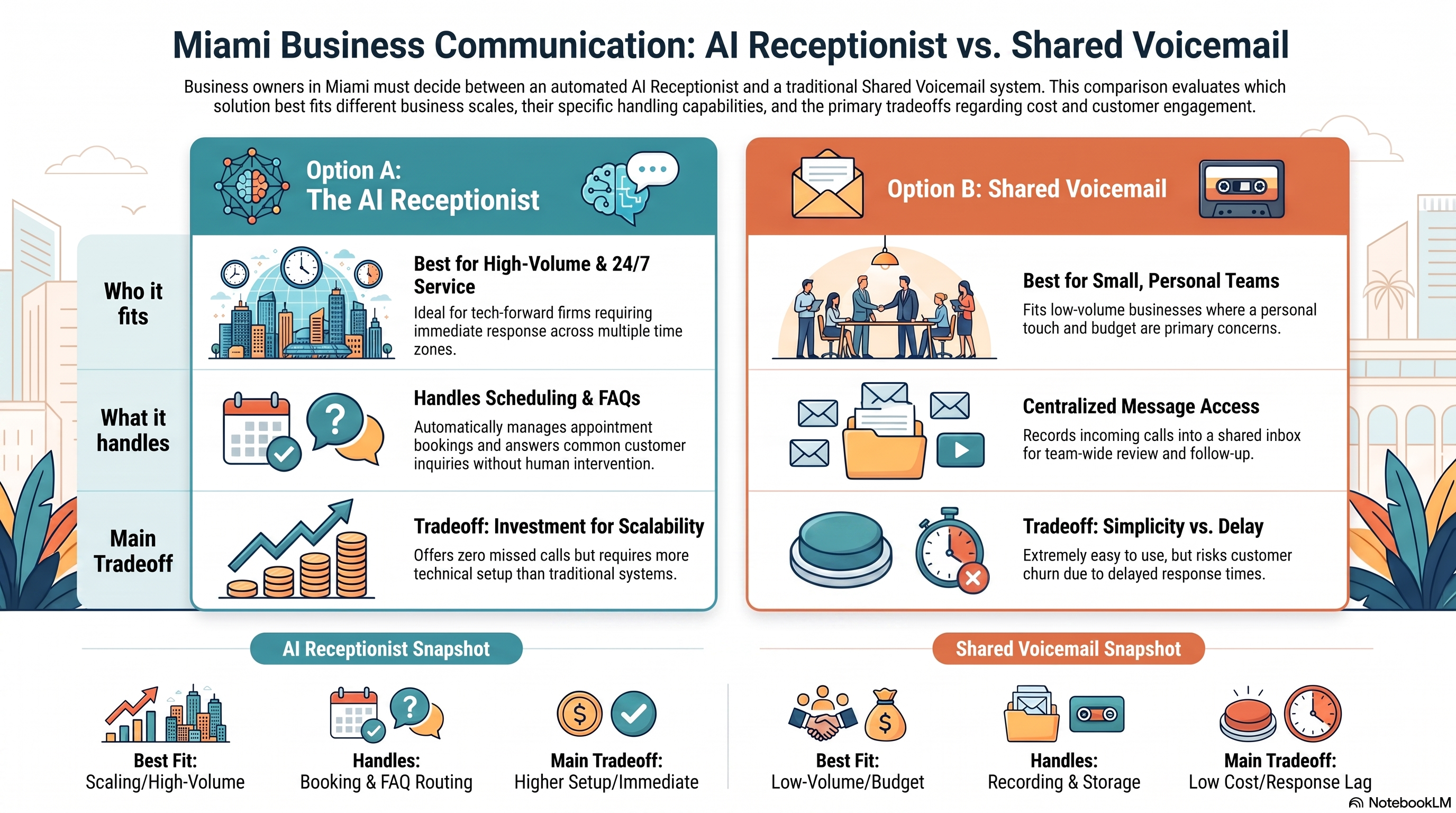
Miami service businesses often compare tools that look similar on paper but behave very differently once the phone starts ringing.
A shared voicemail box seems simple. It catches missed calls and lets the team listen later.
An AI receptionist does something else. It answers right away, collects the basics, routes the call, and hands staff a cleaner summary.
That difference matters most when the business is busy, the caller expects a quick response, or the first conversation needs more structure than a voicemail can provide.
What shared voicemail does well
Shared voicemail is easy to understand and easy to launch.
If a small team only needs a place to store messages, it can work as a backup. It gives staff one place to check later and does not require much setup.
That makes it useful for very low-volume situations or as a safety net behind another system.
Where shared voicemail falls short
Shared voicemail still leaves the business with the same problem it had before the call was missed: someone has to review it, decide what matters, and call back.
That creates delay.
It also leaves room for inconsistency. One person may return a message quickly. Another may wait until the end of the day. Urgent calls and routine questions sit in the same box until someone opens them.
For Miami businesses that depend on speed, that gap can be the real issue.
What an AI receptionist changes
An AI receptionist is useful when the business wants the first response to be more than "leave a message."
It can answer calls right away, ask for the caller's name and callback number, separate routine questions from urgent ones, route the caller to the right next step, and send staff a short summary instead of a voicemail transcript.
That does not replace the team. It gives the team better context before they call back.
The decision point is not technology
The real question is operational.
Ask what happens after the call is missed.
If the answer is "we will listen later and call them back," shared voicemail is probably enough for now.
If the answer needs to include routing, qualification, after-hours handling, or a faster response path, voicemail is probably doing too little.
What Miami businesses should compare
Before choosing one path, compare the actual call flow.
Which calls are routine and which need a person? How fast does the business need to respond? Who checks messages, and when? What happens after hours? Which calls should never sit in a generic inbox?
Those questions usually make the tradeoff obvious.
When voicemail is still fine
There are cases where voicemail is enough.
If the business has very low call volume, no urgency, and a strong habit of reviewing messages quickly, shared voicemail can still be a practical fallback.
It is also useful as a backup for overflow.
When an AI receptionist is the better fit
An AI receptionist is a better fit when the business cares about first-response speed, wants a consistent intake flow, or loses leads because nobody gets to the voicemail fast enough.
That is common in Miami, where caller expectations are often shaped by same-day service, busy schedules, and a preference for immediate answers.
The point is not to automate everything. The point is to keep the call from stalling before a person even sees it.
Bottom line
Shared voicemail stores messages.
An AI receptionist helps manage the call.
If the business only needs a place to check missed calls later, voicemail may be enough. If it needs a faster handoff, clearer routing, and fewer leads stuck in a queue, the AI path does more useful work.